Why Oregon attics need this
People think the Oregon attic story is only water. The summer side gets under-pitched, and it should not. The state's average July high is around 82°F in the Willamette Valley, but the attic does not care about the outdoor number. Under dark asphalt shingles in full afternoon sun, the deck routinely hits 115°F to 120°F on plain July afternoons. On a Portland or Salem hot stretch when the outside air pushes 95°F to 100°F, we have pulled probe readings near 130°F. That heat radiates straight down through the ceiling drywall into the bedrooms below, all evening long. Oregon homes are not built for AC the way Texas homes are, so the upstairs sits 10°F to 15°F hotter than the downstairs from late June through September, and a lot of homeowners just open windows and live with it.
The winter side is the second pitch, and in Oregon it is a serious one. Portland averages 156 days of measurable rain a year. Eugene gets 142. From mid-October through May the outside air carries a heavy moisture load almost every day, and that wet air pushes up into your attic through every soffit vent, gable, and ridge gap. Inside the attic it meets warm house-air rising from showers, cooking, and laundry. The two combine, hit the cool underside of the roof deck, and condense. North-facing slopes grow moss and algae. Shingles curl. Insulation slumps and goes flat. The framing softens at the eaves. Mold blooms on the north gable wall, and a typical mold-remediation quote in Multnomah County runs $3,000 to $10,000.
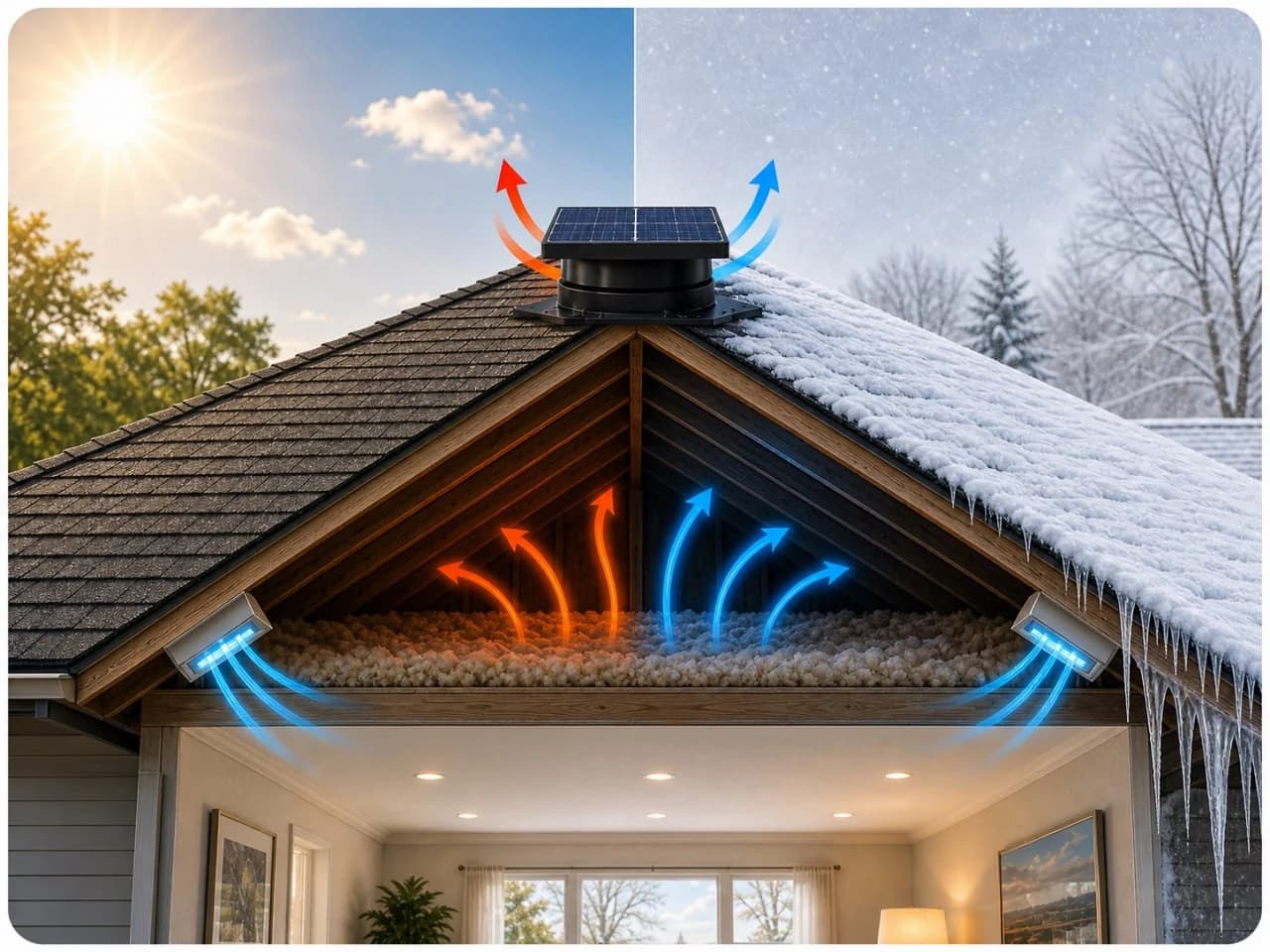
A solar attic fan does both jobs on one piece of equipment. In July it moves the trapped 120°F to 130°F air out and cools the deck dramatically. In November it keeps pulling moist air out before it can condense on the deck, whenever the sun is up. Pacific Northwest summers are sunnier than people give them credit for, and Oregon winter days are bright more often than the rain reputation suggests. Sun runs it year-round. No operating cost added to your bill, which matters in Oregon because the average home already runs about 11,200 kWh per year on all-electric heat.
What we install
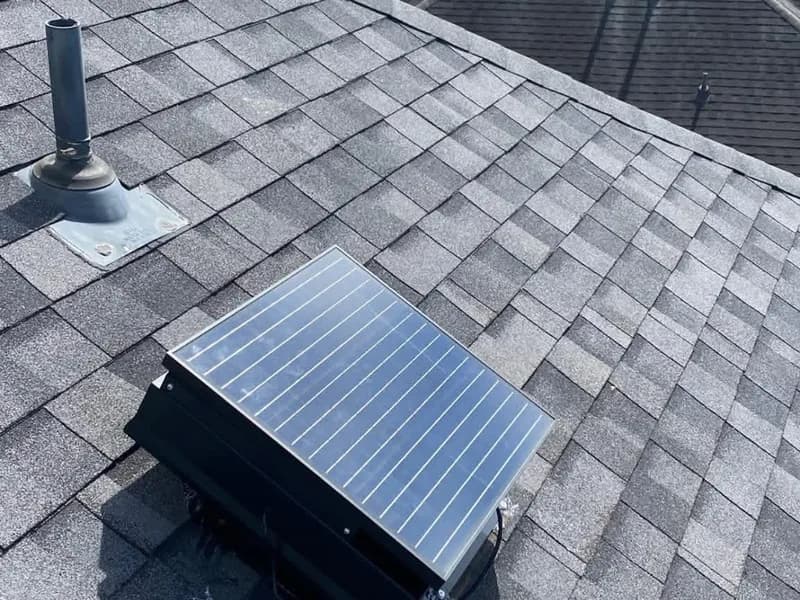
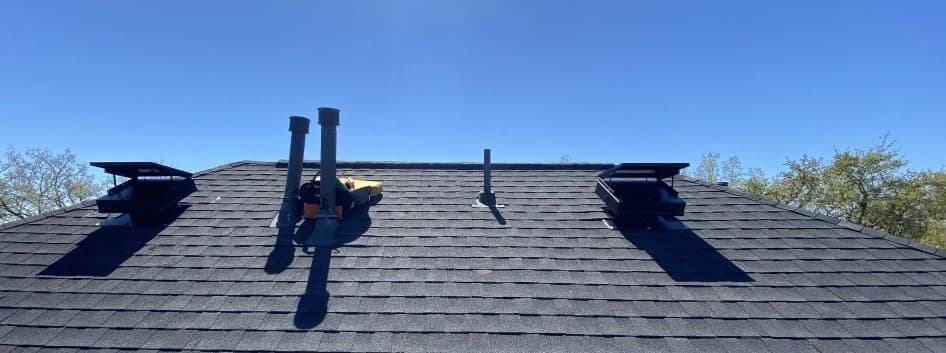
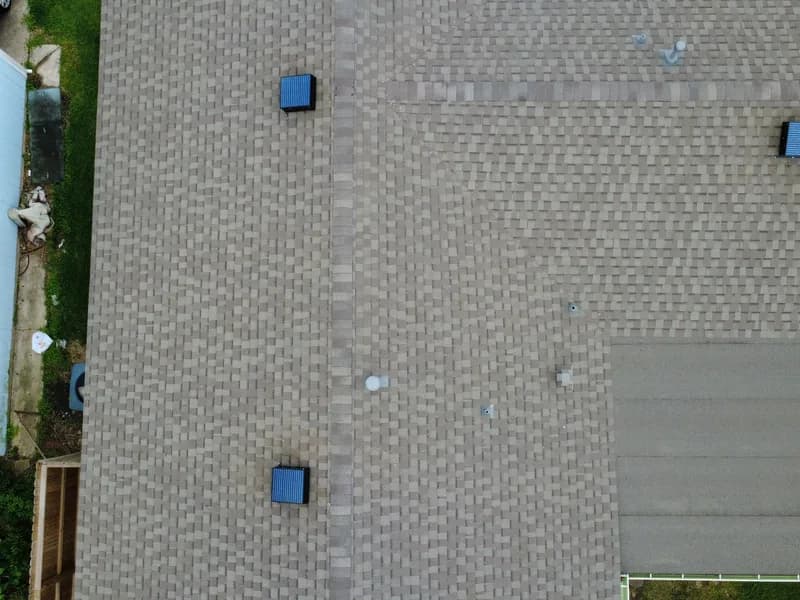
One 30W solar attic fan with the panel built into the housing, mounted on the back slope where it does not show from the street. The authorized installer cuts a clean opening, flashes it for Oregon's near-constant rain, sets a humidistat in the attic (which matters more here than the thermostat), and is back down the ladder in a single visit. No new circuit. No electrician. No operating cost added to your bill.
A note on wildfire smoke season: in late August and September some Willamette Valley homeowners turn the unit off for a week or two when the air goes orange. The fan has a manual cutoff for exactly that. The rest of the year it does what it is supposed to do.
What you'll save
Summer cooling is the first dollar win. The average Oregon summer power bill sits around $115 in July, and a solar fan trims 8 to 15 percent off summer cooling cost (per U.S. Department of Energy residential cooling-load guidance), which is $9 to $17 a month back from June through September. The bigger summer payoff is comfort. The upstairs becomes usable in the evening because the ceiling stops radiating attic heat down into the bedrooms, and that matters in homes that often have no AC at all.
The other wins stack on top, and they are the ones Oregon homeowners care about most. A premature reroof because the deck rotted from below runs $12,000 to $20,000 on a typical 2,000 sq ft home. A mold-remediation job in a Portland or Eugene attic runs $3,000 to $10,000. Wet insulation pushes your winter heat bill up 15 to 25 percent because it stops working as insulation. Shingles in a properly ventilated attic last 5 to 10 years longer in this climate before moss, algae, and trapped moisture cook them from below.
Real Oregon install scenarios
Sellwood-Moreland in Portland. A 1922 four-square with a recent shingle replacement and a beautifully sealed attic floor. Sealed it so well that the moist house-air had nowhere to go. By the second winter the owner saw black streaks on the underside of the deck and a mold-remediation contractor had quoted $6,400. The installer added the solar fan on the back slope with a humidistat. Two months later the deck was dry, the streaks had stopped spreading, and the remediation quote got cancelled.
West University Neighborhood in Eugene. A 1965 ranch near the campus with original cedar shake under two layers of composite shingles. North-facing slope was solid green with moss. Attic smelled like a basement. We added the solar fan on the back slope and the homeowner power-washed the moss off the front. Six months in the attic smelled normal, and the moss did not come back the way it usually does after a wash because the deck stayed dry from underneath.
South Salem hillside home. A 1998 build with vaulted ceilings, complicated roof geometry, and minimal venting. The owner had a recurring wet spot on the kitchen ceiling that two different contractors had failed to fix because it was not a leak, it was condensation. We placed the fan on the back slope above the kitchen and added a humidistat. The wet spot dried out within two weeks of install and has not returned in two winters.
Installed by Oregon authorized installers
Oregon housing splits between 1900 to 1940 in the inner Portland and Salem neighborhoods, 1950 to 1970 ranches in the mid-ring suburbs, and 1990s-on builds in Hillsboro, Tigard, and West Salem. Older stock has venting that made sense for the pre-insulation era and now traps moisture. Newer stock often has impressive air-sealing but no real moisture exhaust. Our installers know how to read which problem you have. Back-slope placement keeps the unit hidden from the street, which clears every Lake Oswego, West Linn, and Bethany HOA rule we have run into.
You pick a date, the installer shows up, and your attic finally stops holding water.